Alpha Knight Academy is a computational research institute first. We work on hard questions in drug discovery and diagnostics, and our students learn by working on them with us, on the same GPUs.
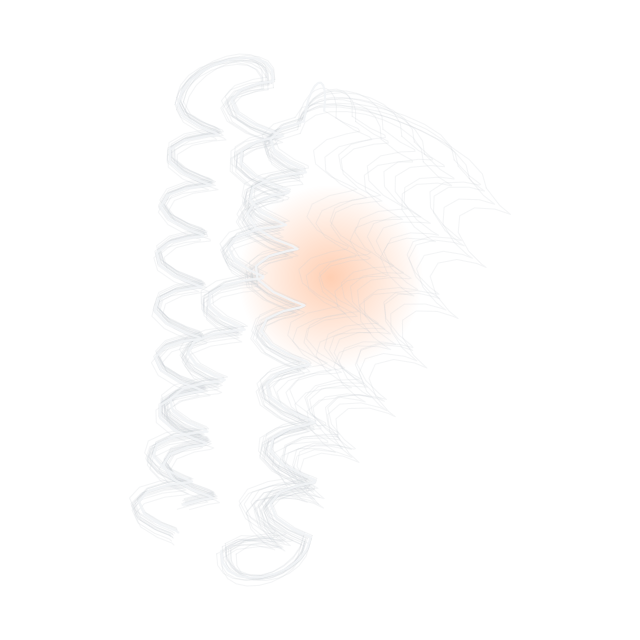
Fourteen conformations of one helix bundle. One helix swings open, and a pocket appears that a single structure would miss.
Research directions
Nine, and growing
Compute
RTX 50-series to H100
Students
Work on live questions
Results
Published in the Archive
Where we point the compute.
Nine directions, each with the kind of question we take on. Students pick one up for their final project and work it to the end.
10 directions
Biomarkers
Extracellular vesicles as biomarker sources
Cells shed tiny vesicles, most of them 30 to 150 nanometres across, that carry proteins, lipids and microRNA from the cell that made them. In blood, they are a sample of tissues you can't biopsy.
Example question
Can a panel of plasma vesicle microRNAs separate early-stage disease from healthy controls, and does it still work on a cohort it has never seen?
Small RNA-seq
Proteomics
Feature selection
External validation
Next training: Omics and Biomarker Scientist (in development)
Methods
Conformation prediction
Structure predictors return one confident shape. Proteins visit many, and drugs often bind the rare ones.
Example question
The switch-II pocket of KRAS G12C is barely visible in early structures, yet it is where sotorasib binds. Can simulation plus machine-learning clustering find pockets like it before a ligand reveals them?
Molecular dynamics
Enhanced sampling
ML clustering
Ensemble docking
Learned in: Motion, Fold, Binder
Diseases
Predicting metabolic disorders
Type 2 diabetes and fatty liver disease (MASLD) build quietly for years. The early signal is often already in routine data.
Example question
From routine clinical labs and metabolomic profiles, who will progress from prediabetes to type 2 diabetes within five years, and how sure can a model honestly be?
Leakage-safe splits
Survival models
Calibration
Interpretability
Learned in: Backbone, Binder
Diseases
Oncology
Cancer drugs fail when tumours mutate around them. Resistance is a structural problem as much as a clinical one.
Example question
EGFR C797S removes the cysteine that osimertinib bonds to. Which reversible binders can still hold the pocket, and how would we rank them before anyone makes them?
Covalent docking
Mutation scanning
Free-energy perturbation
Learned in: Fold, Motion, Lead
Diseases
Neurological disorders
A brain drug has to cross the blood–brain barrier, and most molecules can't. Potency means little if the compound never arrives.
Example question
For a series of LRRK2 inhibitors, a Parkinson's disease target, can we predict brain penetration and trade it against potency, instead of finding out in animal studies?
CNS MPO scoring
Permeability models
ADMET learning
Kinase docking
Learned in: Lead, Binder
Targets
Ion channels
Channels set the rhythm of nerves and the heart. The hard part is hitting one subtype without touching its near-identical cousins.
Example question
Nav1.7 is a validated pain target; Nav1.5 runs the heart. Which residues in the voltage-sensor binding site let a ligand tell them apart?
Membrane simulation
State-dependent docking
Selectivity FEP
hERG liability
Learned in: Fold, Motion
Targets
GPCRs
About a third of approved drugs act on G protein-coupled receptors. They flex between inactive and active shapes, and a drug's effect depends on which one it favours.
Example question
Small-molecule GLP-1 receptor agonists, the oral alternative to injected peptides, bind differently from the natural hormone. What holds the receptor in its active state?
Active and inactive states
Membrane MD
Markov state models
Docking to states
Learned in: Fold, Motion
Targets
Kinases
More than 500 human kinases share one ATP pocket. Selectivity is the whole game, and resistance mutations keep changing the rules.
Example question
Imatinib fails against the ABL T315I gatekeeper mutation; ponatinib doesn't. Can free-energy calculations reproduce that difference, and predict the next mutation that breaks a drug?
DFG-in and DFG-out
Kinome selectivity
Relative FEP
Resistance scanning
Learned in: Fold, Motion, Lead
Diseases
Rare diseases
There are thousands of rare diseases, and most have no approved treatment. Computation is cheap enough to try where large programmes don't.
Example question
Gaucher disease comes from a misfolded enzyme, glucocerebrosidase. Which approved drugs could act as pharmacological chaperones, helping it fold and reach the lysosome?
Example questions show the kind of work we take on. They are not published results; those go to the Project Archive.
Spotlight
A blood draw that remembers its cells.
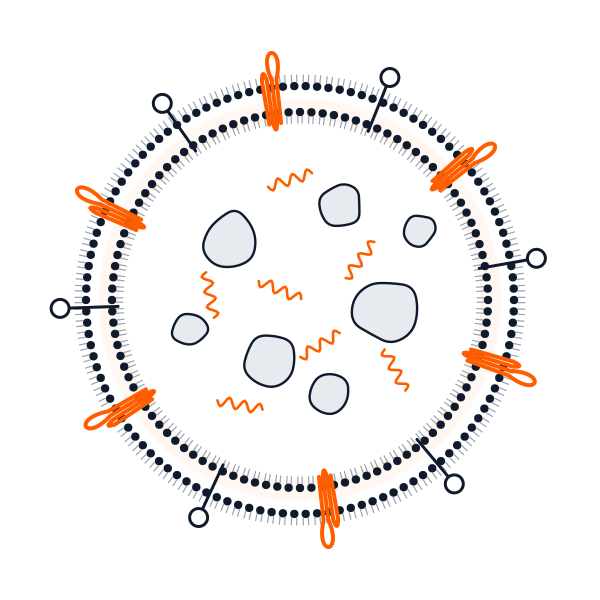
Extracellular vesicles leave tumours, neurons and liver cells and travel in the blood with a sample of their parent's contents. Read them well and a routine blood draw tells you about tissue you would otherwise need a biopsy for.
Tetraspanins CD9, CD63, CD81: the markers that identify a vesicle
MicroRNA cargo
Proteins from the parent cell
Lipid bilayer
ProfileSmall RNA-seq and proteomics
CleanBatch effects, normalisation
ModelFeature selection, honest validation
TestA cohort the model never saw
What we build with.
Six capabilities sit under every direction. Students train in all of them and go deepest in the ones their role needs.
Small molecules and binders
Finding and refining molecules that hold the right protein, and only that one.
Docking
Free energy
Generative design
Biomolecular simulation
Watching proteins move, so designs survive contact with reality.
MD
Enhanced sampling
Markov models
Platform development
Pipelines that turn a week of manual setup into one command.
Snakemake
Nextflow
SLURM
Biomarker discovery
Signals in biological data that are worth a clinical test.
Feature selection
Validation
Advanced omics
Making sense of genomes, transcriptomes and proteomes at scale.
RNA-seq
Proteomics
Metabolomics
AI in biologics
Machine learning for protein binders and protein design.
Protein language models
Diffusion design
Real GPUs, real jobs.
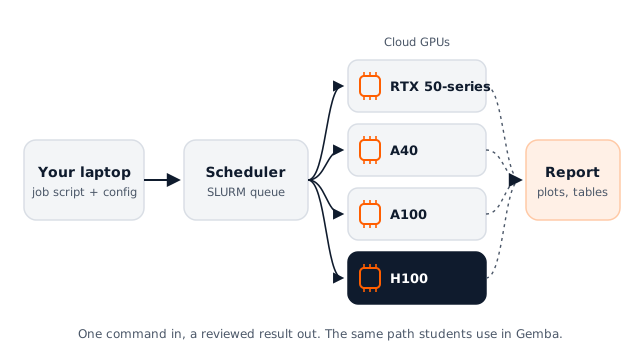
Cloud access to four classes of NVIDIA GPU. Students run production simulations and train models on them, not demos, through the same scheduler a research cluster uses.
GPU
Memory
What we run on it
RTX 50-series
up to 32 GB
Docking campaigns, model inference, quick simulations
A40
48 GB
Production molecular dynamics, replicate runs
A100
40–80 GB
Free-energy calculations, model training
H100
80 GB
Large models, protein language models, structure prediction at scale
SLURM
Apptainer
Conda
Git
Snakemake
The people.
A founder who leads drug discovery programmes, engineers who build the pipelines, and a widening circle of researchers. We're bringing more minds in so AKA becomes a global platform.